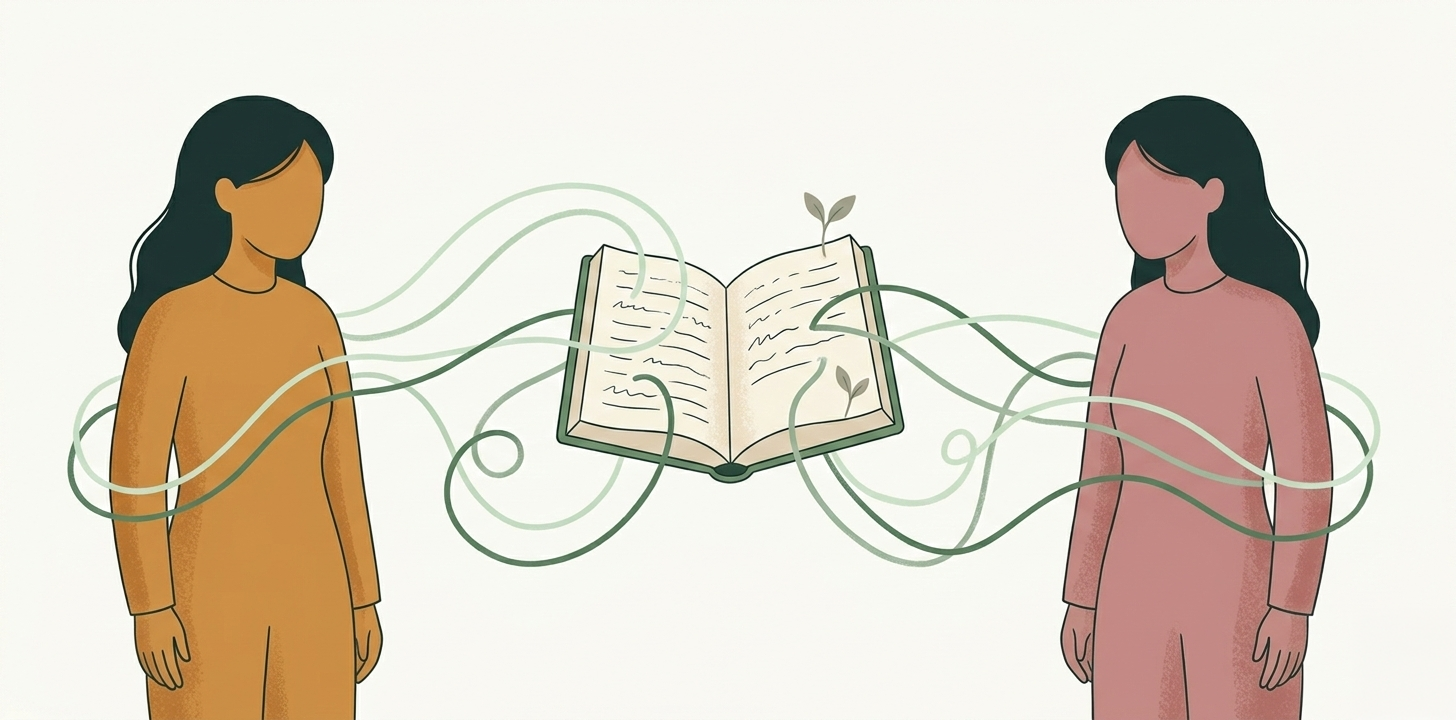
Journal Prompts for Relationships
Prompts to help you understand your patterns and show up better.
Prompts to help you understand your patterns and show up better.
Every relationship you're in is also a relationship with yourself. The way you love, argue, pull away, cling, overexplain, or go quiet, none of that happens in a vacuum. It grew somewhere. It was shaped by your earliest experiences of what love felt like, whether love was safe or conditional, whether conflict meant danger or just disagreement. If you've ever found yourself repeating the same dynamic in different relationships and wondering why, this is the work that starts to answer that question.
Journal prompts for relationships aren't about cataloguing what's wrong with the people in your life. They're about understanding your own patterns so you can choose differently. They're about recognizing the difference between what you were taught love looks like and what you actually need. They're about becoming the kind of person you want to be in a relationship, romantic or otherwise, not because you're broken, but because growth in relationships is one of the most meaningful kinds of growth there is.
Relationship journaling works because it creates distance between your automatic responses and your considered choices. In the middle of a fight, or in the thick of a slow drift from someone you love, it's nearly impossible to see clearly. Writing gives you that clarity. It lets you say the things you're not ready to say out loud. It lets you notice the thought underneath the reaction, and the feeling underneath the thought.
Dr. John Gottman's decades of research at the University of Washington on couples showed that self-awareness and emotional intelligence are among the strongest predictors of relationship health. People who can identify and articulate what they feel, and who understand what they're bringing to their relationships from their past, consistently have better outcomes. Journaling builds exactly that capacity. Dr. James Pennebaker's work at the University of Texas at Austin found that writing about emotionally significant relationships reduces stress, improves immune function, and helps people construct more coherent narratives from confusing or painful experiences.
These prompts cover the full landscape: romantic partnerships, friendships, family dynamics, and the relationship patterns that show up across all of them. If you're working through something specific with a partner, our couples journal prompts offer a more targeted set of exercises designed for two people to explore together. If your relationship patterns connect to how you feel about yourself, journal prompts for self-love can be a grounding companion. And if you're processing a relationship that has ended, our breakup journal prompts will meet you where you are.
A 2021 study published in the Journal of Social and Personal Relationships found that self-reflective writing about relationship experiences increased empathy and reduced defensive responses in subsequent interactions. You don't need to have the right words before you start writing. You just need to start. The clarity tends to follow.
Relationship patterns are some of the most entrenched patterns we carry. They were formed before we had language for them, encoded in the nervous system before we understood what a nervous system was. Journaling doesn't change those patterns overnight, but it does something essential: it makes the invisible visible.
Many of our strongest relationship reactions, the ones that feel disproportionate, the ones that surprise even us, are responses to the past, not the present. When a partner's silence feels like abandonment rather than introversion, when a family member's criticism triggers shame rather than mild irritation, you're often responding to an old wound wearing a new face. Journaling creates enough distance to ask: is this really about now, or am I somewhere else? That question alone can change everything.
Attachment theory, developed by John Bowlby and expanded by researchers like Mary Ainsworth and, more recently, Sue Johnson and Stan Tatkin, describes the strategies we develop in childhood to stay close to caregivers. Those strategies, secure, anxious, avoidant, or disorganized, don't disappear in adulthood. They show up in how we text someone we're falling for, how we react to a friend who cancels plans, how we handle a parent's disapproval. Journaling helps you see your attachment patterns in real time, in your own words, which is the first step toward shifting them.
Research by Dr. Marc Brackett at the Yale Center for Emotional Intelligence shows that people with larger emotional vocabularies regulate their emotions more effectively and navigate relationships with greater skill. "I feel bad" is less actionable than "I feel dismissed," which is less specific than "I feel dismissed when I share something important and you check your phone, because I interpret it as a sign that what I'm saying doesn't matter to you." Journaling trains you to find the right word, and the right word opens up the right conversation.
One of the most powerful things about relationship journaling over time is being able to look back. The dynamic that felt completely hopeless six months ago, the conversation you were terrified to have, the pattern you thought you'd never break, your journal holds the evidence that things actually can change. That evidence matters when you're in the middle of the hard part and can't see the other side yet.
The prompts below are organized into five categories that move from the inside out. Your Relationship Patterns starts with the foundation: the habits, histories, and attachment strategies you bring to every relationship. Communication and Conflict addresses the moments that make or break closeness, how you fight, how you repair, what you avoid saying. Love Languages and Connection explores what you need to feel loved and how well you're meeting others' needs. Family Dynamics goes to where it all began, the relationships that set the template for every one that followed. And Growth and Vision asks where you want to go: who you want to become in relationship, and what kind of connections you're building toward.
You don't need to work through these in order. Start with the category that holds the most charge for you today. Some of these prompts will feel immediately alive; others may not resonate until a specific situation calls them forward. Trust that instinct, and return when it's time.
Before you can change a pattern, you have to see it. These prompts help you map the recurring dynamics in your relationships, the roles you tend to play, the styles of connection you default to, the things you consistently seek out or consistently avoid. Many of these patterns were formed in your earliest relationships and have run largely on autopilot ever since. Writing about them doesn't immediately dismantle them, but it makes them conscious, and consciousness is where the possibility of change lives.
Looking across multiple relationships rather than just one reveals patterns that are impossible to see from inside any single dynamic. When you see the same thread running through three different people, you know the thread is yours.
This prompt asks you to describe your attachment style in plain language rather than categories. The goal is felt understanding, not just intellectual labeling. What does anxious or avoidant actually look like in your specific life?
The relationship you watched most closely as a child is one you absorbed without realizing it. Writing about it explicitly brings unconscious modeling into the light where you can actually evaluate it.
How you handle conflict is one of the most revealing things about you as a partner, friend, or family member. Most people either learned that conflict is dangerous and should be avoided at all costs, or that it is a contest to be won. Neither of those serves relationships well. These prompts explore what gets in the way of honest communication, what your arguments are really about underneath the surface, and what you need to feel safe enough to tell the truth.
The surface argument is almost never what the argument is really about. Asking 'what was the underlying need' consistently reveals more than dissecting who said what. This distinction is the foundation of Gottman's approach to couples communication.
Unsent letters are among the most powerful journaling tools in existence. Writing what you haven't said often reveals more about your own inner world than about the other person. You may or may not ever send it; that is entirely beside the point.
Dr. Gary Chapman's concept of love languages, the idea that people give and receive love through different primary channels, words of affirmation, acts of service, receiving gifts, quality time, and physical touch, has become part of the cultural conversation for good reason. Understanding how you naturally express love, and how you need to receive it, is not just pop psychology. It points toward the specific kinds of mismatches that can make two people who genuinely care for each other still feel unloved. These prompts explore both sides of that equation.
The gap between how we show love and how others need to receive it is one of the most common sources of relational disconnection. Neither person is wrong; they're just speaking different languages. This prompt helps you see your side of that gap.
Your family of origin is where you first learned what relationships are: whether they are safe, how much you have to earn love, who is allowed to need things, how conflict works, whether you matter. Those early lessons are written deep, and they show up in your adult relationships whether you invite them or not. These prompts help you look honestly at those early dynamics, not to assign blame, but to understand what you inherited and to decide, consciously, what you want to carry forward.
Families vary enormously in how they handle emotional expression. Some punish sadness, some reward stoicism, some treat anger as danger. Whatever your family's rules were, they became your rules too, and they travel with you into every relationship.
Relationships are not just things that happen to you. They are also things you build, tend, and choose. These prompts shift from examination to intention, asking what you want your relationships to look like, who you want to become as someone who loves others, and what growth you're most ready for. This is not about designing a perfect relationship on paper. It is about getting clear enough on your values and needs that you can move toward them with intention.
Shifting from 'what do I want' to 'who do I want to be' reorients relationship journaling toward agency and values. The person you aspire to be in relationships is someone you can start becoming today, in small ways, with the people already around you.
Journaling about relationships requires a particular kind of honesty, the kind that can feel uncomfortable because the people we're writing about are people we love, or have loved, or are trying to love better. Here's how to make the most of this practice.
1. Write for yourself, not for the relationship. Your journal is not a rehearsal space for arguments or a place to build a case. If you catch yourself writing in a way that sounds like you're preparing for court, pause and redirect. The goal is understanding your own experience, your feelings, your patterns, your needs. The other person gets their own inner life; you don't have access to it.
2. Write about behavior, not character. It's easy to reach for global judgments when we're hurt: "She's so selfish," "He never cares." These feel satisfying to write but don't actually teach you anything. Push yourself toward specifics: "When she canceled our plans without explaining why, I felt unimportant. I wonder if I've ever made her feel that way." Specificity generates insight. Judgment generates heat.
3. Bring curiosity to your strongest reactions. The responses that feel biggest, the ones that surprise you, the ones you're a little ashamed of, those are the most valuable entry points. Intense reactions are rarely just about what they appear to be about. Ask: what does this remind me of? When have I felt this way before? What am I afraid this means?
4. Include what you're contributing. This is the hardest part of relationship journaling and the most valuable one. It's easy to write about what other people are doing. The prompts here will consistently push you to also write about what you're bringing to the dynamic, your assumptions, your defenses, your needs you haven't communicated, your patterns that might be creating what you're experiencing. This isn't about self-blame. It's about agency.
5. Write about what you want, not just what's wrong. Relationship journaling can become a litany of complaints if you're not careful. For every entry that names a problem, try to include at least a few sentences about what you actually want: in this relationship, in relationships generally, in yourself as someone who shows up for others.
6. Give yourself permission to contradict yourself. You can love someone and be furious at them. You can want more closeness and simultaneously be terrified of it. You can miss someone who hurt you. Relationships are full of contradiction, and your journal should be too. If you're only writing one side, you're editing.
7. Return to prompts that made you hesitate. The question you skipped, the one that made you close the journal, holds something. You don't have to go there today. But notice it, and come back when you're ready. Those are usually the prompts doing the most important work.
A note on privacy: Writing honestly about people in your life means writing things you wouldn't want them to read. Use a journaling app with a passcode or keep a private physical journal. Protecting your writing space is not secrecy, it's what allows genuine honesty.
Journaling improves relationships primarily by improving your self-awareness, and self-awareness is one of the strongest predictors of relationship quality. Dr. John Gottman's research found that emotionally intelligent people who understand their own feelings and triggers are significantly better at navigating conflict, expressing needs, and sustaining intimacy. When you journal, you start to see your patterns: the ways you typically respond under stress, the needs you have difficulty communicating, the fears that drive reactions you later regret. You can't change a pattern you can't see, and journaling makes the invisible visible. Over time, this leads to more intentional responses, clearer communication, and less automatic repetition of dynamics that aren't working.
The most useful relationship journaling covers three areas: your feelings and what drives them, your patterns and where they come from, and what you actually need and want. Try writing about what's working and what isn't with honesty about your own contribution to both. Explore recurring conflicts and what might be beneath the surface of them. Examine how you communicate when things are easy versus when they're hard. Write about your history: what you absorbed from early relationships about what love looks like and who you have to be to receive it. And write about your vision: not just what you want from others, but who you want to become as someone who loves and is loved.
Yes, significantly, though it works best alongside therapy or other support rather than as a standalone solution for severe attachment difficulties. Attachment patterns are deep, formed in early childhood, and encoded in the nervous system as much as in the mind. Journaling helps by making your attachment behaviors visible to you in real time. When you write about how you responded to a partner's withdrawal, or why you felt the need to check in five times in one afternoon, or why closeness suddenly felt suffocating, you start to see the pattern operating. That recognition is genuinely the first step. Research on narrative therapy, developed by Michael White and David Epston, shows that people can create new relationship narratives through writing that gradually replace old ones. For attachment work specifically, look for prompts that ask about early relationships and what you learned about safety in connection.
Relationship journal prompts are guided questions or writing starters designed to help you explore your experiences, feelings, and patterns in your relationships with others. Unlike a blank page, which can feel overwhelming, a prompt gives you a specific angle of entry into the material. Good relationship prompts move between the emotional and the analytical, asking you to name what you feel and then to examine where that feeling comes from or what it might be telling you. They cover both the external, what happens between you and others, and the internal, what you bring to those interactions from your history, beliefs, and needs. They're useful for people in relationships who want to communicate better, people who've noticed recurring patterns they want to understand, and people doing broader personal growth work around how they connect.
There's no single right answer, but consistency tends to matter more than frequency. Writing three to four times a week produces noticeable benefits according to research by Dr. James Pennebaker, whose decades of work on expressive writing found that even brief, regular sessions build meaningful self-awareness and emotional processing. For relationship journaling specifically, many people find it useful to write after significant interactions, after a conflict, a meaningful conversation, or a moment that stirred something unexpectedly. This captures the material while it's still vivid. Others prefer a weekly reflection practice where they review the week's relational moments from a slight distance. Some do both. The best schedule is the one you'll actually maintain, and a five-minute honest entry beats a two-hour session you never start.
Journaling alone cannot save a relationship, but it can make a meaningful contribution to the work of saving one. What journaling does exceptionally well is build self-awareness, reduce reactivity, and help you get clear on your own needs and feelings before having difficult conversations. A 2021 study in the Journal of Social and Personal Relationships found that self-reflective writing about relationship experiences increased empathy and reduced defensiveness in subsequent interactions. So while a journal can't substitute for honest communication, couples therapy, or the hard work of repair, it can make you a better, clearer, more present participant in all of those things. If you're working through challenges as a couple, you might also explore our dedicated couples journal prompts, which are designed for two people doing this work together.
Start by giving yourself permission to write honestly without editing for fairness. In a first draft of difficult feelings, you don't need to be balanced. Write what's true from your experience first. Once it's on the page, you can come back with questions: what am I contributing here? What does this person need that I might not be seeing? What old wound might be getting activated in this dynamic? The goal is to move from venting to insight, from what they did to what it means, what I need, and what I want to do about it. Avoid writing in circles: if you notice yourself returning to the same complaint repeatedly without any new understanding, try a structured prompt that asks a specific question. Also be careful about privacy, write about difficult relationships somewhere secure, because the fear of someone reading it will limit your honesty.
The best journal app for relationship work makes it easy to write honestly, keeps your entries private, and gives you guided prompts so you don't face a blank page when you're already emotionally depleted. Look for an app that offers structured prompts around specific themes, secure privacy features like a passcode or biometric lock, and a clean interface that doesn't make the writing feel like a chore. Seedlit was built with this kind of intentional journaling in mind: it surfaces thoughtful prompts for relationships, self-awareness, and emotional growth, and it's designed to feel calm and accessible even when what you're writing about is neither. The best app is ultimately the one that removes friction and makes the practice something you'll return to, especially on the days when it feels hardest.
Seedlit is a free journaling app with daily prompts, mood tracking, and a plant that grows when you write. No account needed.

Available on iOS. Android coming soon.

Prompts to help you and your partner connect, communicate, and grow together.
→
Prompts to build genuine self-compassion | beyond affirmations.
→
Prompts for processing heartbreak, rediscovering yourself, and moving forward.
→
Prompts for emotional healing | processing pain and finding your way forward.
→
Evidence-based prompts to build genuine self-confidence from the inside out.
→
Prompts to help you sit with anxious thoughts and write through them.
→