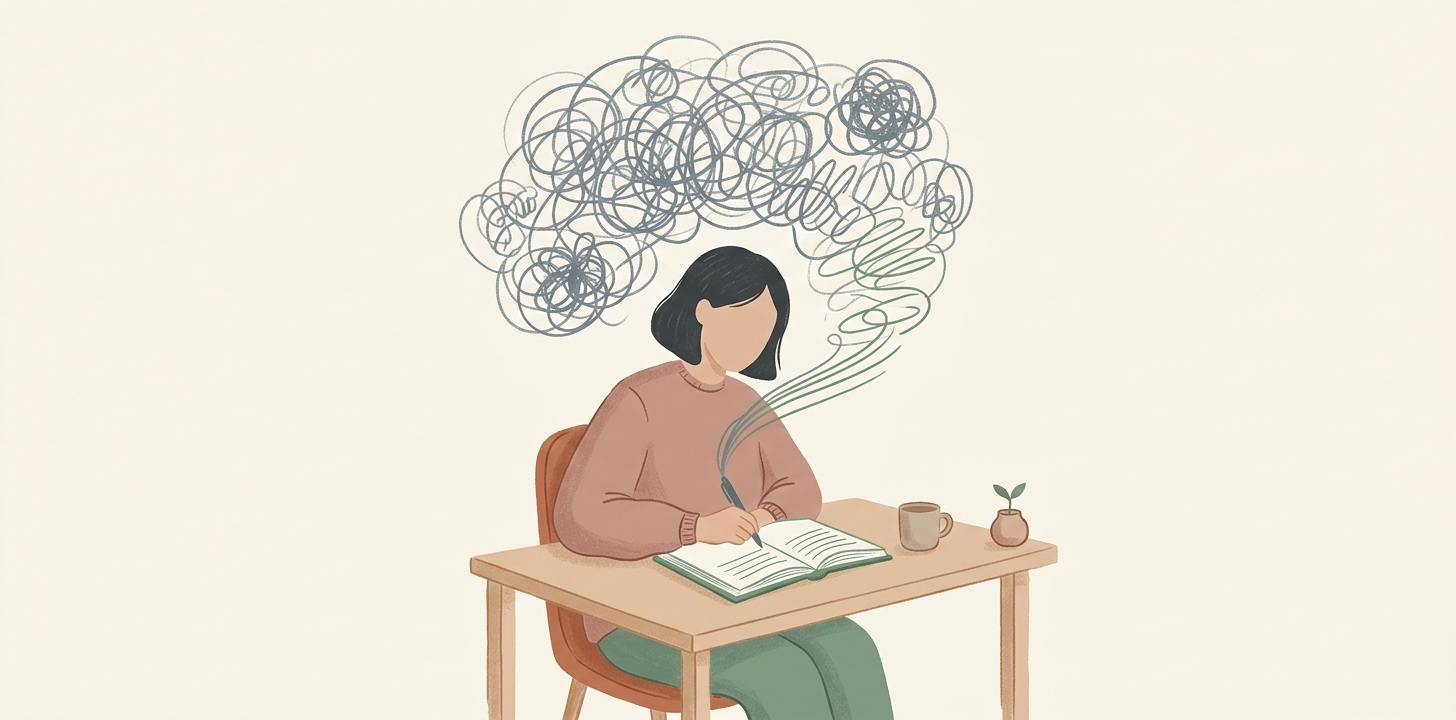
Journal Prompts for Anxiety
Gentle prompts to slow down your racing thoughts and write toward calm.
Gentle prompts to slow down your racing thoughts and write toward calm.
If you're here, there's a good chance your mind is loud right now. Maybe it's a low hum of dread you can't quite name. Maybe it's a spinning loop of what-ifs that won't let you rest. Maybe your chest is tight and your thoughts feel like they're moving faster than you can follow. Whatever shape your anxiety takes today, you're welcome here exactly as you are.
Journal prompts for anxiety aren't about fixing what's wrong with you, because nothing is wrong with you. They're about giving your overwhelmed mind a place to put things down. When anxious thoughts stay inside your head, they bounce off the walls and amplify. When you move them onto paper, or onto a screen, something shifts. The worry doesn't disappear, but it becomes something you can look at instead of something that's looking at you.
Anxiety journaling works because it interrupts the cycle. Researchers at UCLA, led by Dr. Matthew Lieberman, found that the simple act of putting feelings into words, a process called affect labeling, reduces activity in the amygdala, the brain's alarm system. Writing about your anxious thoughts is not navel-gazing. It's a neurological intervention. Dr. James Pennebaker at the University of Texas at Austin spent decades studying expressive writing and consistently found that people who wrote about emotional experiences showed measurable improvements in both mental and physical health.
These anxiety journal prompts are organized to meet you wherever you are today. Some are gentle and grounding, designed for moments when you need to come back to your body. Others ask you to look more closely at your thought patterns, to question the anxious narratives that feel so convincing. And some help you build forward, creating a personal toolkit of strategies that actually work for you.
If you're also working through feelings of low mood alongside anxiety, our journal prompts for depression may feel like a natural companion. For those moments when anxiety connects to deeper, harder-to-name emotions, shadow work journal prompts can help you look beneath the surface. And if you're early in a broader healing process, our healing journal prompts offer a wider lens.
A 2018 study published in JMIR Mental Health by researchers at the University of Rochester found that online positive affect journaling significantly reduced anxiety and perceived stress in participants with elevated anxiety symptoms, with effects appearing in as little as one month. You don't need to write perfectly. You don't need to write a lot. You just need to start.
Below, you'll find over 50 writing prompts for anxiety, organized into categories that address different facets of the anxious experience. Use the generator to get a single prompt when you need a starting point, or browse the full list to find what speaks to you. There is no wrong way to do this.
Anxiety lives in the gap between what you feel and what you can articulate. It thrives in vagueness: the unnamed dread, the shapeless worry, the sense that something is wrong without knowing what. Journaling for anxiety works because it forces specificity. You cannot write "everything is terrible" for very long before your pen starts asking what, exactly, is terrible. That specificity is where the power is.
Dr. Matthew Lieberman's neuroimaging research at UCLA demonstrated that when people label their emotions in writing, activity in the amygdala decreases while the prefrontal cortex, responsible for rational thinking, becomes more engaged. In practical terms, writing about your anxiety shifts your brain from reactive mode to reflective mode. You move from being inside the panic to observing it. This is not a minor distinction. It's the difference between drowning in a wave and watching it from the shore.
Anxious thinking is circular. The same worries replay on a loop, each repetition adding urgency without adding information. Dr. James Pennebaker's research at the University of Texas at Austin found that expressive writing helps people construct a coherent narrative from fragmented emotional experiences. Once a worry has a beginning, middle, and structure on the page, it loses some of its power to spin endlessly in your mind. A 2017 study by Schroder, Moran, and Moser at Michigan State University found that expressive writing freed up cognitive resources in anxious individuals, essentially giving the brain back some of the bandwidth that worry had been consuming.
Anxiety often feels random, but it rarely is. When you journal consistently, you start to see the architecture of your anxiety: the situations that trigger it, the times of day it peaks, the stories your mind tells that make it worse. This pattern recognition is enormously valuable. You can't change what you can't see, and anxiety journal prompts are designed to help you see clearly. Over time, your journal becomes a map of your inner landscape, showing you not just where the danger zones are, but also where the solid ground is.
The prompts below are organized into six categories, each addressing a different dimension of anxiety. Identifying Triggers & Patterns helps you map the landscape of your anxiety so it feels less random. Grounding & Self-Compassion brings you back to the present moment and softens the inner critic that often accompanies worry. Reframing Anxious Thoughts teaches you to question the narratives anxiety builds. Building Your Calm Toolkit helps you catalog what actually works for you. Looking Forward gently reconnects you with possibility beyond the worry. And Anxiety in Relationships & Work addresses the specific contexts where anxiety often hits hardest.
You don't need to work through these in order. Start with the category that matches where you are today. Some prompts are quick and accessible; others go deeper. Trust yourself to know what you need.
Anxiety often feels like it arrives out of nowhere, but there are almost always patterns underneath. These prompts help you become a detective of your own experience, noticing the situations, thoughts, and conditions that activate your anxiety. When you can name a trigger, it loses some of its ambush power. Over time, this category builds a map that helps you anticipate and prepare rather than just react.
This is a strong starting prompt. Tracing the sequence from event to thought to sensation builds awareness of how your anxiety actually operates, not how it feels from inside it.
Writing anxious thoughts as direct quotes creates distance between you and the thoughts. You stop being the anxiety and start being the person observing it.
When anxiety pulls you into the future or traps you in spiraling thoughts, grounding brings you back to the present moment. These prompts combine sensory awareness with self-compassion because anxiety is hard enough without the added weight of judging yourself for having it. The goal here is not to stop the anxiety but to soften your relationship with it and remind yourself that you are more than your worst fears.
This visualization prompt activates the parasympathetic nervous system. The more vivid the sensory detail, the more calming the effect. Take your time with this one.
Anxiety is a convincing storyteller. It presents worst-case scenarios as certainties and feelings as facts. These prompts aren't about toxic positivity or pretending everything is fine. They're about learning to question the automatic thoughts that anxiety generates, to hold them up to the light and ask: is this actually true? Cognitive behavioral research consistently shows that examining anxious thoughts on paper weakens their grip.
This is the core CBT technique of thought challenging, adapted for journaling. The evidence question is deceptively simple but remarkably effective at loosening anxious certainty.
Stripping out catastrophic language reveals how much intensity anxiety adds to neutral situations. 'I might fail' and 'I will definitely fail and everyone will think I'm useless' describe the same event with very different emotional weight.
Everyone's nervous system responds to different things. What calms one person might do nothing for another. These prompts help you build a personalized inventory of what actually works for you, so that when anxiety hits, you don't have to figure it out from scratch. Think of this as assembling your own emergency kit, documented in your own words, ready when you need it.
Writing this when you're calm and keeping it accessible is genuinely practical. During high anxiety, your prefrontal cortex goes partly offline, so having a pre-written plan means you don't have to think clearly in the moment.
Anxiety is future-focused by nature, but it only shows you threatening futures. These prompts gently redirect that forward gaze toward possibility, hope, and what you're building. They're not about ignoring real problems. They're about remembering that the anxious forecast is not the only one available to you, and that you have more resilience than your worry gives you credit for.
This prompt builds evidence against the anxious belief that you can't handle things. Your history of surviving hard moments is the strongest counterargument to anxiety's predictions.
Anxiety doesn't exist in a vacuum. It shows up in how we relate to the people around us and how we function at work or school. Social anxiety, performance anxiety, attachment anxiety, these are specific contexts that deserve specific attention. These prompts address the places where anxiety intersects with your daily life and responsibilities, helping you untangle what's yours from what's situational.
Over-preparing and people-pleasing are common anxiety-driven behaviors that often go unrecognized because they look productive or kind on the surface. Naming the anxiety underneath them is the first step toward choosing differently.
Anxiety journaling doesn't require a special notebook, a quiet room, or an hour of free time. Here's how to make it work in real life.
1. Start with five minutes. Set a timer if it helps. The research on expressive writing shows benefits from sessions as short as five to ten minutes. If you write for longer, great. But five minutes of honest writing is better than an hour you never start.
2. Write when the anxiety is present, not after it passes. The most powerful journaling happens in the moment. When you feel the tightness rising, the what-ifs multiplying, that's when writing can intervene. Keep your journal or a journaling app accessible so there's no barrier between you and the page.
3. Don't edit. Don't perform. This writing is for you. It doesn't need to be grammatical, coherent, or polished. Misspell words. Write in fragments. Let it be messy. The value is in the expression, not the product. If you're worried about someone reading it, write it in a secure app or destroy the pages after.
4. Use a prompt when you're stuck, not when you're flowing. If you sit down and words pour out, follow them. Prompts are scaffolding for the days when anxiety has you frozen and you don't know where to start. Pick one that resonates and let it pull you forward.
5. Ground yourself first if the anxiety is intense. Before writing, try 30 seconds of slow breathing or the 5-4-3-2-1 sensory grounding technique. If a prompt takes you somewhere that feels overwhelming, pause. Write about what you notice in your body. You can always return to the prompt later, or choose a gentler one.
6. Close with one true thing. End each session by writing one thing you know to be true right now. It can be small: "I am sitting in my chair. The sun is coming in the window. I got through today." This anchors you back in reality after exploring anxious territory.
7. Notice what you don't want to write about. Resistance is information. The prompts that make you want to skip ahead are often the ones holding the most insight. You don't have to tackle them today, but make a mental note. When you're ready, they'll be waiting.
Important: Journaling is a powerful self-support tool, but it is not a replacement for professional help. If your anxiety is significantly impacting your daily functioning, relationships, or ability to work, please reach out to a licensed therapist or counselor. These prompts work beautifully alongside professional support.
Yes, and there is substantial research behind it. Dr. James Pennebaker's decades of work at the University of Texas at Austin showed that expressive writing reduces anxiety symptoms, improves mood, and even strengthens immune function. A 2018 study in JMIR Mental Health found that positive affect journaling reduced anxiety and perceived stress in just one month. Journaling works by moving anxious thoughts from your internal loop onto the page, where they become something you can examine rather than something controlling you. It activates the prefrontal cortex and reduces amygdala reactivity. That said, journaling is most effective as one tool in a broader approach that may include therapy, exercise, social support, and other strategies.
Start simple. Set a timer for five to ten minutes, choose a prompt that resonates, and write without stopping to edit or judge what comes out. The goal is honest expression, not polished writing. Write in whatever format feels natural: sentences, bullet points, fragments, even drawings. If you don't know what to say, start with what you notice in your body. If a prompt feels too intense, switch to something lighter like a gratitude list or a sensory grounding exercise. The key is consistency over perfection. Even short, regular writing sessions build the self-awareness muscle that helps you understand and manage anxiety over time.
Research suggests that writing three to four times per week is enough to see meaningful benefits, though daily journaling can be even more helpful during high-anxiety periods. Consistency matters more than duration. Five minutes of genuine reflection four days a week will do more than one long session followed by weeks of nothing. Many people find that morning journaling helps set a calmer tone for the day, while evening journaling helps process the day's stress before sleep. Experiment with timing and frequency to find what works for your life. The best journaling schedule is the one you can actually maintain.
Start with what's right in front of you. Name the emotion and where you feel it in your body. Then try to identify the specific thought underneath the anxious feeling. "I feel anxious" is a start, but "I feel anxious because I'm convinced my boss is going to criticize my presentation tomorrow" gives you something concrete to work with. From there you can examine the thought: what's the evidence? What's the most likely outcome? What would I tell a friend? If the anxiety is too intense to analyze, switch to grounding: describe your surroundings in detail, list things you're grateful for, or write about a memory where you felt safe.
Journaling is most useful before and after a panic attack, not usually during one. In the middle of a panic attack, your body is in fight-or-flight mode and fine motor skills like writing become difficult. In that moment, focus on breathing, grounding techniques, or calling someone you trust. However, journaling after a panic attack is extremely valuable. Writing about what happened, what triggered it, how it escalated, and how it resolved helps you build understanding and reduce the fear of future attacks. Over time, journaling between episodes can help you identify early warning signs and intervene before a full panic attack develops.
It can if you approach it in a way that becomes rumination on paper, writing the same fears over and over without ever stepping back to examine them. The key difference between helpful journaling and written rumination is reflection. Effective anxiety journaling moves from describing the worry to questioning it, contextualizing it, or responding to it with self-compassion. Using structured prompts helps prevent the rumination trap by guiding you toward insight rather than circles. If you notice that writing consistently makes you feel worse rather than better, try gentler prompts like gratitude lists or grounding exercises, and consider working with a therapist who can help you process what's coming up.
Research points to two particularly effective approaches. Expressive writing, as studied by Pennebaker, involves writing openly and honestly about your emotional experiences without worrying about structure. Cognitive journaling, rooted in CBT principles, involves identifying anxious thoughts and examining them for distortions and evidence. In practice, the most effective anxiety journaling often combines both: express what you feel first, then gently question the thoughts driving those feelings. Some people also benefit from gratitude journaling and structured prompts that prevent open-ended rumination. The best type is whichever one you'll actually do consistently. Experiment with different approaches and notice what leaves you feeling lighter rather than heavier.
Look for an app that makes it easy to write quickly without friction, since any barrier between you and the page means you're less likely to journal when anxiety hits. Helpful features include daily prompts so you never face a blank screen, mood tracking to identify patterns over time, privacy features so you feel safe writing honestly, and reminders to keep you consistent. Seedlit was designed with exactly these needs in mind: it offers daily curated prompts, gentle mood check-ins, and a private, calming interface that makes journaling feel approachable even on your hardest days. The best app is the one that removes excuses and makes the habit stick.

Seedlit is a free journaling app with daily prompts, mood tracking, and a plant that grows when you write. No account needed.

Available on iOS. Android coming soon.

Gentle prompts for when everything feels heavy. Start small.
→
Prompts for emotional healing | processing pain and finding your way forward.
→
Prompts to build genuine self-compassion | beyond affirmations.
→
Start your day with intention. Five minutes of writing that changes everything.
→
Explore unconscious patterns, triggers, and the parts of yourself you've been hiding.
→
New to journaling? Start here. Easy prompts, zero pressure.
→