
Journal Prompts for Couples
Prompts to help you and your partner connect on a deeper level.
Prompts to help you and your partner connect on a deeper level.
Somewhere between the daily logistics of life together, the shared grocery lists, the scheduling, the accumulated small decisions, it becomes easy to lose the thread of each other. Not in any dramatic way. Just gradually. You sleep in the same bed, share the same kitchen, and still find yourself wondering when was the last time you really talked. If that resonates with you or with you and your partner together, these journal prompts are here to help you find your way back to each other.
Journaling for couples is not about diagnosing what's broken. Most relationships that benefit from reflective writing are not broken at all. They are simply busy, and busyness is the quiet enemy of intimacy. The day-to-day noise crowds out the conversations that matter most, the ones about what you each need, what you hope for, what you appreciate, what you've been afraid to say. Journal prompts for couples create a structured invitation for those conversations to happen.
These prompts can be used in different ways. Some couples find it meaningful to each write separately in their own journals, then share what feels right to share, a kind of written conversation that gives both partners space to think before speaking. Others prefer to write together, sitting across from each other with the same prompt, building something like a shared map of their inner worlds. A few couples use prompts as the beginning of a verbal conversation, using the question as a launching point rather than writing at all. There is no single correct method. What matters is that you're both choosing to pay attention to each other.
If you're working through a difficult period in your relationship, you may also find our relationship journal prompts useful for broader reflection on how you connect with others. For those moments when caring for your relationship begins with caring for yourself first, our self-love journal prompts can help you show up as your best self. And if you want to build a foundation of appreciation between you, our gratitude journal prompts offer a powerful place to start.
Relationships are the most researched human behavior for good reason. They profoundly shape our health, happiness, and sense of meaning. Dr. John Gottman at the University of Washington spent more than four decades studying what makes couples thrive or fail, and his findings are consistently clear: the quality of a couple's friendship, how well partners know each other's inner worlds, is the single strongest predictor of relationship satisfaction. Journal prompts for couples are, at their core, tools for building that friendship. They help you stay curious about the person you love, even when you think you already know everything about them.
You might be surprised what you still don't know. After years together, people change in ways they forget to announce. Dreams shift. Fears evolve. New things become important. One of the gifts of couples journaling is that it creates a regular practice of asking and it turns out that asking is one of the most loving things you can do.
Below, you'll find over 40 relationship journal prompts organized into five categories that address different dimensions of life together. Whether you're newly partnered or have been together for decades, whether things are going beautifully or feeling strained, there are prompts here that will meet you where you are.
The research on what makes relationships last is clearer than most people realize. Dr. John Gottman's longitudinal studies at the University of Washington identified what he calls the "Sound Relationship House," a model of the core elements that sustain long-term partnership. At the foundation of that house is something deceptively simple: love maps. A love map is your knowledge of your partner's inner world, their stresses, their dreams, their history, their fears, their preferences. Couples with rich love maps, Gottman's research showed, were dramatically better at navigating conflict, recovering from hard times, and sustaining intimacy over decades. Journal prompts for couples are, in a very direct sense, love map builders. They prompt you to ask questions and share answers that most couples never get around to in the busyness of daily life.
One of the most consistent findings in relationship research is that the way partners communicate, particularly during disagreement, predicts relationship outcomes better than the frequency of conflict itself. Gottman identified four communication patterns he called the Four Horsemen: criticism, contempt, defensiveness, and stonewalling. These patterns erode connection over time. Journaling gives couples a low-stakes space to practice honesty before a conversation gets heated. Writing about what you feel, what you need, and what you appreciate gives you language you can bring into verbal conversations more calmly and clearly. It's a kind of rehearsal for the real thing.
In Gottman's research, the most telling moments in a relationship are not the big romantic gestures or the dramatic arguments. They are the small daily "bids for connection," the moments when one partner reaches toward the other for attention, affirmation, or engagement. Couples who consistently "turn toward" these bids rather than turning away or against them build a reservoir of positive connection that sustains them through difficulty. Journaling together, or sharing what you've written, is a bid for connection and a response to one simultaneously. It's a way of saying: you are worth my attention. I am curious about your inner world. I am here.
When relationships are under stress, couples can fall into what Gottman calls negative sentiment override, a state where even neutral actions by a partner are interpreted negatively. Writing prompts that focus on appreciation, gratitude, and positive shared history actively counteract this dynamic. A 2012 study published in the Journal of Social and Personal Relationships found that expressing gratitude to a partner not only increased the expressing partner's sense of relationship satisfaction, but also led the receiving partner to feel more appreciated and to express more communal strength in the relationship. Gratitude journaling for couples creates a positive feedback loop that builds warmth on both sides.
One of the underappreciated challenges of long-term partnership is that two people are always growing and changing, sometimes toward each other and sometimes in directions that create distance. Regular reflective writing helps couples stay updated on each other's evolving values, goals, and needs. Rather than waking up one day to discover that the person you love has become a stranger, couples who reflect and share regularly have ongoing access to who their partner is becoming. That sustained curiosity is one of the most powerful forces in keeping love alive.
The prompts below are organized into five categories, each addressing a different dimension of life together. Getting to Know Each Other (Again) helps you stay curious and updated on each other's inner worlds, because people change and the best relationships keep pace with those changes. Communication and Conflict gives you language for the harder conversations, the ones about needs, ruptures, and repair. Dreams and Goals Together keeps you oriented toward a shared future and makes sure you're growing in the same direction. Intimacy and Appreciation builds the positive emotional bank account that sustains connection through difficult periods. And Fun and Playful reminds you that joy and lightness are not luxuries in a relationship. They are necessities.
You don't need to work through categories in order. Choose the section that fits where you are today, or use the generator to receive a prompt at random. Some prompts will feel easy and fun; others will open doors you haven't walked through in a while. Trust each other with what you find on the other side.
Dr. John Gottman's research found that couples with rich "love maps," deep knowledge of each other's inner worlds, are significantly more resilient during stress and conflict. But people change. The person you fell in love with is not identical to the person sitting across from you today, and that's not a problem. It's an invitation. These prompts help you stay genuinely curious about your partner and share things about yourself that may have quietly shifted without announcement. Some answers will surprise you. That's the point.
This is a powerful opening prompt because it asks two things simultaneously: what is true in your inner world right now, and what is blocking you from sharing it. The second question is often where the more important information lives.
Family of origin patterns shape how we behave in relationships in ways we often can't see ourselves. This prompt invites vulnerable disclosure without requiring either partner to have done therapeutic work to participate meaningfully.
Gottman's research is unambiguous: it's not whether couples fight, it's how they fight and how they repair afterward. These prompts aren't designed to start arguments. They're designed to give both of you language before the heat rises, so that when difficult conversations are necessary, you're better prepared to have them with care. Writing about what you need and how you feel, before you're in the middle of a tense moment, is one of the most practical relationship skills you can build.
Gottman calls these "perpetual problems": the topics that feel too risky or too tired to raise. Writing about the fear beneath the avoidance is often more useful than trying to resolve the issue itself before you feel safe enough to raise it.
Self-awareness about your own conflict patterns is one of the most valuable things you can bring to a relationship. This prompt asks you to look at your own behavior, not your partner's, which makes it safe to answer honestly and less likely to trigger defensiveness.
One of the most quietly damaging things that can happen in a long-term relationship is for two people to stop building a shared future together. Not through any dramatic rupture, but through the gradual accumulation of unshared dreams. These prompts are about making sure you're both looking at the same horizon. They help you articulate what you're hoping for, what you want your life to look like, and whether you're still moving toward those things together.
Many couples discover through this prompt that they have meaningfully different timelines, financial definitions, or core assumptions about what a shared future looks like. That discovery is not a crisis. It's exactly the conversation you need to be having.
Research by Dr. Sara Algoe at the University of North Carolina found that expressing gratitude to a partner not only increases satisfaction for the person expressing it, but also signals to the partner that they are valued, creating a cycle of warmth and mutual investment. These prompts are designed to slow you down long enough to notice what you have, to put into words the appreciation that often goes unsaid, and to explore what intimacy means to each of you beyond the physical.
Specificity is the secret to effective appreciation prompts. Listing five things forces you out of vague warmth and into concrete observation. 'You notice when I'm overwhelmed before I say anything' lands differently than 'you're supportive.' The concrete version is what actually makes a partner feel seen.
Writing a letter of appreciation directed at the version of yourself your partner has helped shape reframes gratitude away from what your partner does and toward who you are becoming together. This is a powerful shift that acknowledges the partnership as a transformative force.
Gottman's research includes a finding that often surprises people: one of the most significant predictors of relationship satisfaction is the presence of genuine friendship and fun. Couples who enjoy each other's company, who laugh together and share a sense of play, are dramatically more resilient than those who approach their relationship as primarily serious business. These prompts are lighter by design. They're here to remind you that joy is not the reward you get after all the hard relationship work. It's part of the work itself.
Nostalgia for a specific day, rather than a general period, creates vivid shared memory and activates what Gottman calls 'positive sentiment override.' If you're in a disconnected phase, revisiting a best day together can soften the distance more quickly than almost any other exercise.
Couples journaling doesn't have to mean sitting side by side in silence with matching leather notebooks. It can take many forms, and finding the one that fits your relationship is more important than doing it the "right" way. Here are approaches that work in real relationships.
1. Decide: together or apart? Some couples thrive writing separately and then sharing. This approach gives each person space to be honest without the pressure of an audience, and the sharing conversation afterward can feel surprisingly intimate. Other couples prefer writing at the same time in the same room, which creates a sense of shared ritual. Some use prompts purely as conversation starters, reading them aloud and talking rather than writing at all. Try a few approaches and notice which one you both actually enjoy.
2. Start with a frequency you can maintain. Once a week is a sustainable starting point for most couples. Even once a month is far better than never. The goal is a practice that fits into your life, not an ideal you resent. You might build up to more frequent sessions once the habit feels natural. Research suggests that even monthly reflective conversations about the relationship significantly improve satisfaction over time.
3. Agree on ground rules before you start. If you're sharing what you write, establish a few simple agreements first: that you'll listen without interrupting, that neither person will use what's shared as ammunition in future arguments, and that it's okay to say "I'm not ready to share this one yet." Safety is the precondition for honesty, and honesty is the point.
4. Choose prompts that match your current season. If things are going well, lean into the playful and aspirational categories. If you're in a period of tension, the communication prompts can help you find words for things that are hard to say. If you feel disconnected, start with the "Getting to Know Each Other Again" section and let curiosity soften the distance. Don't force yourself into prompts that feel premature or too raw.
5. Don't treat it as conflict resolution. Couples journaling is not couples therapy, and prompts are not the place to relitigate old arguments. If a prompt surfaces something genuinely difficult, write about your own feelings and needs rather than the other person's failures. If significant issues emerge, consider working with a licensed couples therapist who can help you navigate them with proper support. Journaling works beautifully alongside therapy, not as a replacement for it.
6. Celebrate the small moments of connection. After a sharing session, notice if you feel closer to your partner. Name it. Say it aloud. Small acknowledgments of connection reinforce the habit and remind both of you why you're doing this in the first place. The point is not the writing. The point is the two of you.
There are several approaches that work well for different relationship styles. You can each write separately using the same prompt and then share what feels comfortable to share afterward, this approach gives each person space for honest reflection without an audience. You can write at the same time in the same room as a shared ritual. Or you can skip the writing entirely and use prompts purely as conversation starters, reading them aloud and discussing. What matters most is that both partners feel safe to be honest. Start by agreeing on a few ground rules: listen without interrupting, don't use what's shared as ammunition later, and make it okay to say 'I'm not ready to share this one.' Once the safety is established, the depth tends to follow naturally.
The best couples journal prompts are the ones that open doors rather than close them. Look for prompts that invite curiosity and vulnerability rather than prompts that assign blame or require your partner to defend themselves. Strong categories include getting to know each other at a deeper level (your partner's current dreams, fears, and inner world), appreciation and gratitude (specific things you value about your partner and your life together), shared goals and vision for the future, and playful questions that remind you both how to enjoy each other. The Seedlit prompt generator includes all of these categories and delivers a single focused prompt when you need a starting point without the overwhelm of choosing.
Research strongly suggests that reflective writing practices improve relationship quality. Dr. John Gottman's longitudinal studies showed that couples with rich knowledge of each other's inner worlds, what he calls 'love maps,' are far more resilient during stress and significantly more satisfied over time. A 2012 study in the Journal of Social and Personal Relationships found that expressing gratitude to a partner increased relationship satisfaction for both the person expressing it and the person receiving it. Journaling builds both of these capacities: it deepens your knowledge of each other and creates a structured space to express appreciation. The key is consistency and psychological safety. Brief, regular journaling sessions are more effective than occasional deep-dives you can't sustain.
Once a week is a sustainable and meaningful starting point for most couples, and research supports even monthly reflective conversations as beneficial for relationship satisfaction. The most important factor is not frequency but consistency and follow-through. A journaling ritual you can actually maintain is far more valuable than an ambitious practice you abandon after three sessions. Many couples find that ten to twenty minutes on a weekend morning, before the day gets busy, works well. Others prefer a midweek check-in. Experiment with timing and frequency until you find a rhythm that feels like something you look forward to rather than something you schedule out of obligation.
Yes, though the mechanism matters. Journaling improves relationships primarily by building two things: self-awareness and expressed connection. Self-awareness helps you understand your own emotional patterns, needs, and communication habits so you can bring a more reflective version of yourself to your relationship. Expressed connection, whether through sharing what you've written or using prompts as conversation starters, keeps you updated on each other's evolving inner worlds. Dr. John Gottman's research found that the depth of a couple's mutual knowledge and the frequency of positive emotional expression are among the strongest predictors of long-term relationship satisfaction. Journaling, practiced regularly, builds both. It works best alongside, not instead of, direct honest conversation.
The most valuable couples journal writing covers five broad areas. First, your inner world right now: your current joys, fears, hopes, and frustrations that your partner may not know about. Second, appreciation and specific gratitude for your partner and your life together. Third, your communication patterns: what you find easy and difficult to say, and what you need that you're not asking for. Fourth, your shared future: your dreams, goals, and the life you're trying to build together. And fifth, your shared history: the memories, moments, and experiences that form the story of your relationship. You don't have to cover all of this in every session. Follow whatever feels most alive or most needed on a given day.
The easiest start is to choose one prompt, sit together, set a timer for ten minutes, and write. Don't overthink the format. After you write, decide together whether to share what you wrote or simply to talk about what the prompt brought up for you. Keep the first session light: choose something from the 'getting to know each other' or 'fun and playful' categories rather than immediately diving into communication or conflict. The goal of your first session is simply to establish that this is something you do together and that it feels good. Once that's true, you can go deeper. You might also try the Seedlit prompt generator, which delivers a single prompt so you don't have to decide together, removing one potential point of friction before you even begin.
The best journal app for couples is one that makes the practice easy, private, and consistent enough that both partners actually use it. Look for an app with a library of prompts organized by topic so you're never staring at a blank screen, a clean and calming interface that doesn't make journaling feel like another productivity task, strong privacy settings so you feel safe writing honestly, and a prompt generator that removes the decision fatigue of choosing where to start. Seedlit was designed with exactly these priorities in mind. It offers curated journal prompts organized by mood and topic, a generator for when you need a starting point fast, and a private, focused writing environment that gets out of the way and lets you connect with what actually matters.
Seedlit is a free journaling app with daily prompts, mood tracking, and a plant that grows when you write. No account needed.

Available on iOS. Android coming soon.
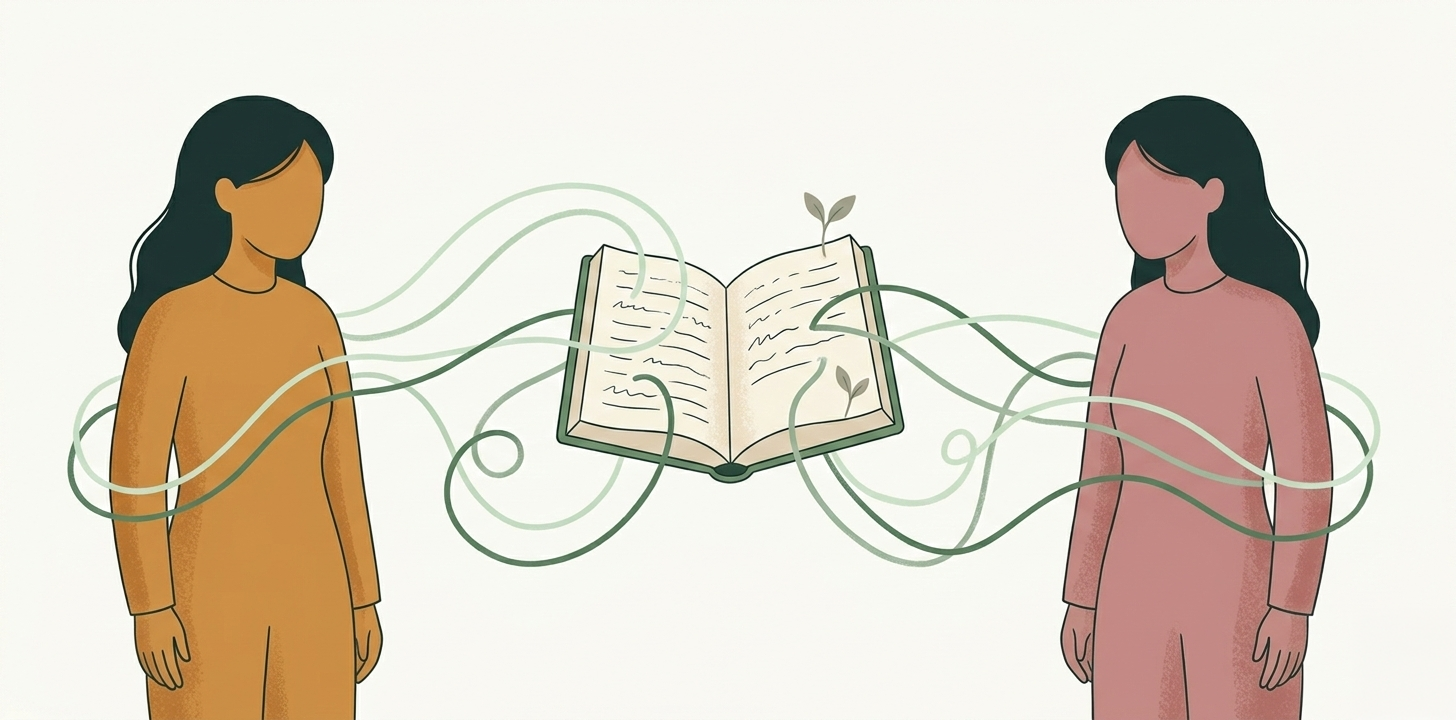
Explore relationship patterns, communication, and what you truly need.
→
Prompts to build genuine self-compassion | beyond affirmations.
→
Daily prompts to help you notice the good | even on hard days.
→
Prompts for processing heartbreak, rediscovering yourself, and moving forward.
→
Evidence-based prompts to build genuine self-confidence from the inside out.
→
Prompts for emotional healing | processing pain and finding your way forward.
→