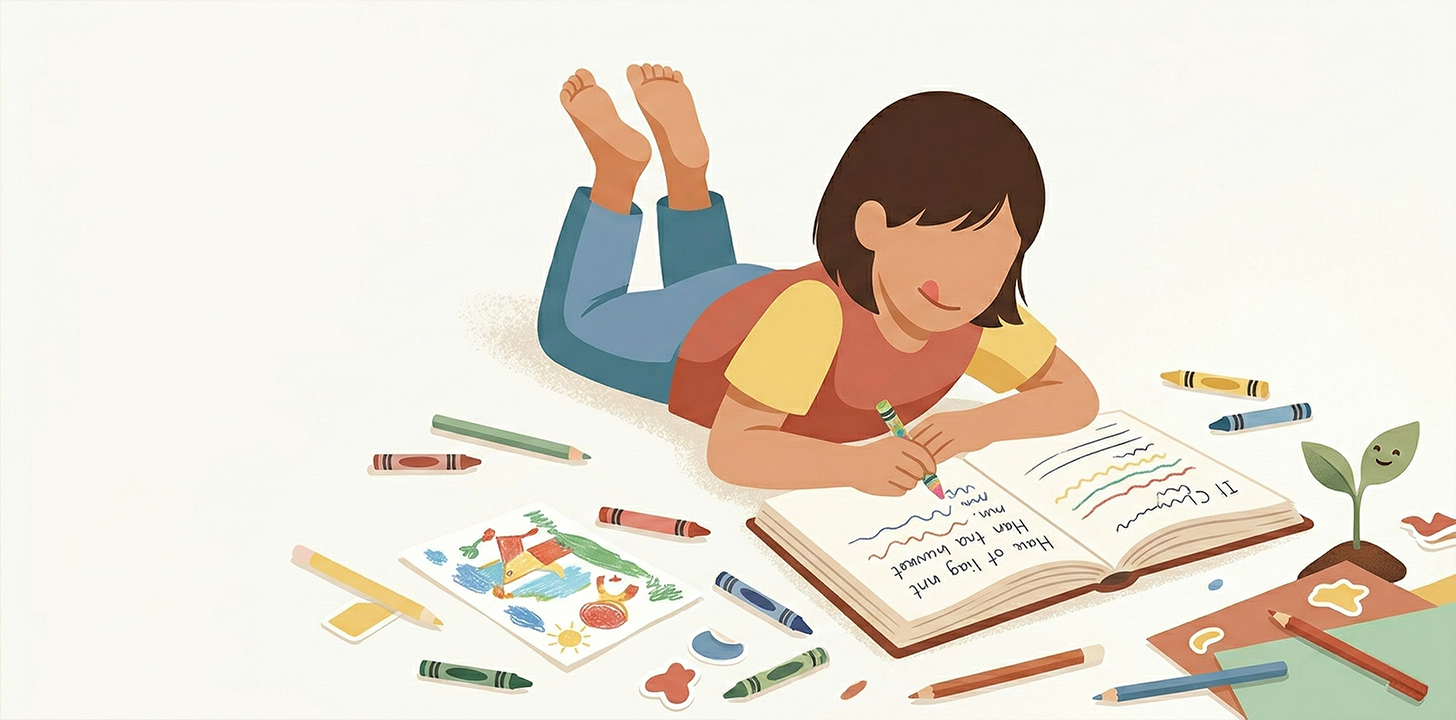
Journal Prompts for Kids
Fun, simple prompts to help kids express themselves and build a writing habit.
Fun, simple prompts to help kids express themselves and build a writing habit.
You already know your child has a rich inner world. You see it in the stories they tell at the dinner table, the elaborate games they invent, the questions they ask at bedtime that stop you in your tracks. Journaling gives that inner world a place to land. It hands your child a tool they can use for the rest of their life: the ability to slow down, pay attention to what they're thinking and feeling, and put it into words.
Journal prompts for kids are one of the most effective ways to get children started with writing, not as a school assignment with a grade attached, but as something they actually want to do. The key is making it feel low-stakes and genuinely interesting. When a prompt speaks to something a child already cares about, their friends, their favorite games, their secret dreams, the reluctance often melts away. You'll find yourself surprised by what they have to say.
Research from child development supports what many parents already sense. A 2011 study published in Psychological Science found that expressive writing helped elementary school children process emotional experiences and reduced behavioral problems over time. Writing gives children a private, pressure-free space to work through the normal but often overwhelming emotional material of growing up: friendship conflicts, school stress, the big feelings that can be hard to bring to a parent or teacher. It's a form of emotional self-regulation that builds with practice.
The prompts in this collection are written directly for children ages 6 to 12, in language they can read and connect with on their own. You'll find prompts that invite pure imagination and silly fun alongside ones that gently encourage your child to name their feelings, appreciate the people they love, and think about who they want to become. There's something here for the kid who needs a creative outlet, the kid who struggles with big emotions, the kid who already loves to write, and the kid who insists they have nothing to say.
If your child is a teenager and has outgrown these prompts, our journal prompts for teens are designed for older kids navigating the more complex questions of adolescence. For adults who want to start their own journaling practice alongside their child, our journal prompts for beginners offer the same gentle, welcoming approach. And if your child has a particularly vivid imagination, the prompts in our creativity journal prompts collection can help them develop that gift further.
You don't need to buy a special journal or set aside a dedicated journaling hour. A notebook, a device, and a few minutes a day is enough. Many families build a journaling habit into a natural pause in the day: after school while the backpack is still being unpacked, before bed as a way to wind down, or on weekend mornings when the day hasn't filled up yet. Wherever you put it, the habit itself is the point. Consistency over perfection. A few honest sentences beats a blank page every time.
Below, you'll find over 35 writing prompts for kids organized into five categories. Use the generator to get your child a fresh prompt each day, or browse together and let them pick what sounds most interesting. The best prompt is whichever one gets them writing.
Parents sometimes wonder whether journaling is really worthwhile for young children, or whether it's just something that sounds good in theory. The evidence is clear: regular writing practice benefits children in ways that go well beyond language arts. Here's what the research and child development experts tell us.
Emotional literacy, the ability to recognize, name, and understand emotions, is one of the most important skills a child can develop, and it's a skill that has to be practiced. Dr. Dan Siegel, clinical professor of psychiatry at UCLA and author of The Whole-Brain Child, describes the process he calls "name it to tame it": when children put their feelings into words, they activate the left brain's capacity for logical processing, which helps calm the right brain's emotional reactivity. In simple terms, writing about feelings helps kids feel less overwhelmed by them. A journal is one of the most accessible tools for this practice, precisely because it's private and there's no right or wrong answer.
Academic research consistently shows that children who write regularly outside of school develop stronger writing fluency, vocabulary, and organizational skills than those who write only for assignments. A 2013 study in the Journal of Educational Psychology found that self-expressive writing tasks motivated children more than purely academic writing, leading to greater engagement and measurably better writing quality. When a child writes about something they actually care about, the mechanics of writing, spelling, sentence structure, paragraph organization, improve naturally through use. Journaling removes the performance anxiety of school writing and replaces it with genuine motivation.
Children face real stressors: academic pressure, social dynamics, family changes, the constant stimulation of modern life. A 2014 study in Child Development found that children who had regular outlets for processing their emotional experiences showed greater resilience in the face of stress and were better able to regulate their behavior in challenging situations. Journaling creates a private container where children can process difficult experiences at their own pace, without needing to perform competence or manage a parent's reaction. It teaches them, over time, that their feelings are survivable and understandable, and that they have the internal resources to work through hard things.
Children who grow up with a regular reflective practice, whether that's journaling, meditation, or conversation, develop what psychologists call metacognition: the ability to think about their own thinking. A 2018 study in Frontiers in Psychology found that metacognitive skills in childhood predicted academic success, emotional regulation, and positive social relationships in adolescence. Starting a journaling habit at ages 6 to 12 gives children years of practice in noticing their own patterns, understanding themselves, and being curious about their inner lives rather than afraid of them. These are habits that compound over time.
The prompts below are organized into five categories, each designed to engage a different part of a child's experience and imagination. All About Me helps kids explore their own identity, preferences, and personality with curiosity and confidence. Feelings and Emotions gives children words and frameworks for the emotional experiences that can feel overwhelming without language. Imagination and Creativity unleashes the storytelling and world-building instincts that are strongest in childhood. Friends and Family helps kids reflect on the relationships that matter most to them. And Dreams and Goals turns the natural optimism of childhood into concrete, motivating thinking about the future.
All prompts are written directly for children ages 6 to 12. You can let your child read and choose their own prompt, read prompts aloud together for younger children, or use the generator to get a fresh surprise each day. There is no order to follow and no wrong way to use them.
These prompts help kids explore who they are: their likes, dislikes, strengths, quirks, and the small details that make them uniquely themselves. Self-knowledge is a gift, and writing about yourself is one of the most interesting things you can do. There are no wrong answers here. The most interesting journals are the honest ones.
The "perfect day" prompt is a classic for good reason. It externalizes a child's values and desires without asking abstract questions. What a child puts in their perfect day tells you a great deal about what they need more of in their actual life.
This is a surprisingly powerful prompt for kids. Most children are not asked often enough what they want others to know about them. The responses are frequently revealing and moving, and kids often feel genuinely seen after writing this one.
Feelings can be confusing and sometimes really big. Writing about them doesn't make them go away, but it can help you understand them better and feel a little less alone with them. These prompts invite kids to name their emotions honestly. All feelings are welcome here | the happy ones, the hard ones, and the ones that are hard to name.
Personifying worry as a character is a technique borrowed from narrative therapy and widely used by child therapists. When anxiety becomes a character | with a shape, a name, a personality | children gain distance from it. It becomes something they can observe and even talk back to.
Asking children to describe a feeling without naming it forces them to pay close attention to their body, which is the foundation of emotional regulation. This prompt builds interoceptive awareness, a skill that research consistently links to emotional intelligence.
Your imagination is one of the most powerful things about you. These prompts are an invitation to go anywhere, be anyone, and dream up anything. There are no rules, no wrong answers, and no limits. The sillier or more creative, the better.
Sentence starters remove the most common barrier to creative writing: not knowing where to begin. This opener is mysterious and open-ended enough to go in hundreds of directions, which gives even reluctant writers an entry point.
The people in your life | your family, your friends, even your pets | are a huge part of who you are. These prompts invite you to write about the relationships that matter most to you and to notice the small, important things about the people you love.
Writing about conflict with a peer or sibling builds perspective-taking skills. Guided reflection on disagreements, as opposed to reactive processing in the moment, helps children develop empathy and conflict resolution abilities that carry forward into adult relationships.
You are growing and changing all the time, and the future is wide open. These prompts invite you to think about what you want, who you want to become, and the things you hope to learn, do, and experience. Dream big. There are no wrong answers when you're imagining your own future.
Asking children to think about changing the world activates their sense of agency and moral imagination at an age when both are naturally flowering. It also reveals what they care most deeply about, which is valuable information for parents.
The letter to a future self is one of the most developmentally valuable prompts for children in this age range. It builds temporal identity, the understanding that there is a continuous "me" across time who is growing and changing. This sense of self-continuity is protective against anxiety and builds a foundation for goal-setting.
Getting a child started with journaling is one thing. Helping them stick with it is another. Here's practical guidance for parents on making journaling a sustainable, enjoyable habit.
1. Let them own it. Resist the urge to read your child's journal without permission. If children know their journal might be read, they'll self-censor, and the emotional and creative value drops dramatically. The privacy of a journal is part of what makes it powerful. Make a clear agreement upfront: this is their private space. The exception is genuine safety concerns, which you can acknowledge matter-of-factly: "Your journal is yours, and I won't read it unless I'm worried you might be in danger." This honesty builds trust and protects the habit.
2. Let them choose the format. Some kids want a beautiful physical notebook. Some want to type on a tablet or computer. Some want to draw more than write. All of these are valid. A journal that feels like theirs, in a format they enjoy, is one they'll actually use. If your child loves art, prompts that invite drawing alongside writing are a great entry point. The writing will grow from there.
3. Start with one prompt, not an open page. For most children, especially those who say "I don't know what to write," a blank page is an obstacle. A specific, interesting prompt removes that barrier entirely. Start each session by picking a prompt together, or using the Seedlit generator to get a surprise prompt. Once the words start coming, most kids surprise themselves with how much they have to say.
4. Keep sessions short, especially at first. For younger children (6 to 8), five to ten minutes is plenty. For older children (9 to 12), ten to fifteen minutes is a solid session. The goal is to build the habit of regular writing, not to produce essays. Short, consistent sessions are far more valuable than occasional marathon writing days. As the habit takes hold, many children naturally begin writing for longer periods without being asked.
5. Make it part of a routine, not a reward or punishment. Journaling works best when it's woven into an existing daily rhythm rather than treated as something special or corrective. Link it to an anchor event: right after school snack, before the evening screen time window, or as part of a bedtime wind-down. Consistency is what turns a single good idea into an actual habit.
6. Model the practice. Children are extraordinarily responsive to what they see adults doing. If you journal yourself, even occasionally, and you mention it naturally, your child absorbs the message that writing is something adults value. Some families do quiet journaling time together: everyone writes for ten minutes, no one is obligated to share, and then the time ends. This makes it a shared practice rather than something imposed on the child alone.
7. Celebrate the habit, not the content. Resist evaluating what your child writes. When they do share, respond with curiosity and interest, not correction or judgment. "That's a really interesting way to think about it" goes much further than "That's good, but you misspelled three words." The goal is to help your child associate writing with self-expression and pleasure, not performance and evaluation. The spelling will improve on its own.
Children can start journaling as soon as they can form simple sentences, typically around age 5 or 6. At that stage, journaling might look more like dictating while a parent writes, or drawing pictures alongside a few words. By age 7 or 8, most children have enough writing fluency to journal independently with simple prompts. The prompts in this collection are designed for children ages 6 to 12, with the understanding that younger kids will need more support and shorter sessions, while older kids in the 10 to 12 range can handle more nuanced emotional and creative prompts. The best time to start is whenever your child shows any interest in writing, drawing, or telling stories.
The most effective approach is to make it feel like their idea rather than your assignment. Start by letting your child choose their own journal, whether that's a notebook, a sketchbook, or a digital app. Use prompts rather than asking them to write freely, since a specific, interesting question removes the "I don't know what to write" barrier immediately. Keep sessions short, especially at first. Five to ten minutes is plenty. Connect journaling to something already enjoyable: let them write about their favorite game, their friends, or a story they love. Avoid reading the journal without permission, as that undermines the safety that makes honest writing possible. And if possible, journal yourself at the same time so it feels like something adults do, not a chore imposed on children.
The best journal prompts for kids are specific enough to get them started but open enough to let them take the response anywhere. They should connect to things children already care about: their friends, their imagination, their feelings, their goals. Prompts that invite storytelling and creativity work especially well for reluctant writers because they feel more like play than writing. Prompts that ask kids to describe something they love in detail, invent something that doesn't exist, or write about a strong memory tend to produce the most enthusiastic responses. Avoid prompts that feel like school assignments or that ask children to evaluate themselves against an external standard. The best prompts are genuinely curious about the child's inner world.
Yes, meaningfully so. Research published in journals including Psychological Science and Child Development has found that expressive writing helps children process emotional experiences, reduces behavioral problems, and builds resilience under stress. Writing about feelings builds emotional literacy, the ability to recognize and name emotions, which is one of the strongest predictors of long-term mental health and positive social relationships. Beyond emotional benefits, regular writing practice improves language skills, vocabulary, and writing fluency. And journaling builds the habit of self-reflection, thinking about one's own thinking, which research links to academic success and emotional regulation throughout life. The benefits are real and they compound over time.
For most children, three to five times per week is a good target. Daily journaling is ideal if your child enjoys it, but consistency matters more than frequency. Three genuine sessions per week will deliver more benefit than daily sessions that feel forced and resentful. For younger children (ages 6 to 8), keep sessions to five to ten minutes. For older children (ages 9 to 12), ten to fifteen minutes is a solid session. The most important thing is to connect journaling to a consistent routine, like after school or before bed, so it becomes automatic rather than something that requires a decision each day. Over time, many children naturally begin writing for longer periods as the habit takes hold and they discover how much they enjoy it.
Kids can write about anything that matters to them. Their day, their friendships, their worries, their dreams, their favorite things, their opinions, and their imaginations are all fair game. The best starting point is always whatever the child is most energized or curious about right now. Structured prompts help enormously, especially for children who say they don't know what to write. Categories that work particularly well for kids include imagination and creative storytelling prompts, prompts about their relationships with friends and family, prompts that help them name and explore their feelings, and prompts about their dreams and goals for the future. The goal is honest, genuine expression, not polished writing. Misspellings, unfinished thoughts, and doodles in the margins are all completely fine.
The secret is to treat it as a creative activity rather than an academic exercise. Give your child full ownership of their journal, including how it looks, what they write, and whether they share it. Use creative, imaginative prompts that feel more like games than assignments. Let them decorate their journal pages, add drawings alongside their writing, or use stickers and colored pens. Some children enjoy themed journaling sessions: one day they write about a made-up world, the next they write a letter to their future self. Using a prompt generator, like the one on this page, adds an element of surprise that many kids find exciting. And periodically remind your child that there are no rules and no grades. The only goal is to write something real.
The best journaling app for children is one that makes writing feel accessible and fun rather than like a chore, and one that keeps their writing private and secure. Look for an app with age-appropriate prompts that spark genuine curiosity, a simple and distraction-free writing interface, and privacy features that protect your child's entries. It's also worth choosing an app without social features or public sharing, since the power of a child's journal comes from its privacy. Seedlit offers daily curated prompts, a calm and simple writing environment, and the kind of gentle structure that helps children build a consistent habit. The best app is whichever one your child will actually open and write in regularly, so let your child try a few options and choose the one that feels right to them.
Seedlit is a free journaling app with daily prompts, mood tracking, and a plant that grows when you write. No account needed.

Available on iOS. Android coming soon.

New to journaling? Start here. Easy prompts, zero pressure.
→
Prompts about identity, friendships, feelings, and figuring it all out.
→
Prompts to unblock your creativity and reconnect with your artistic self.
→
Daily prompts to help you notice the good | even on hard days.
→
Prompts to help you sit with anxious thoughts and write through them.
→
Uncover your values, dreams, and patterns through thoughtful self-reflection.
→