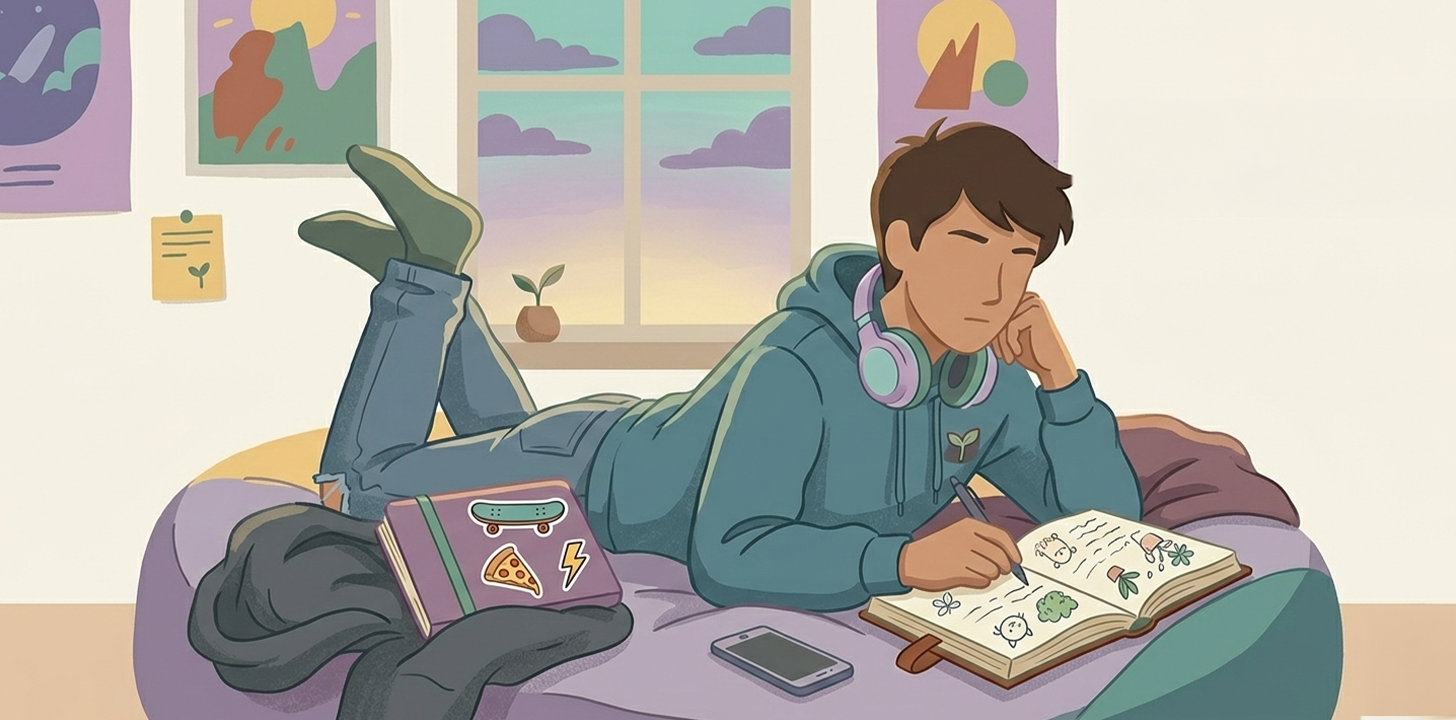
Journal Prompts for Teens
Prompts about the real stuff | identity, friendships, feelings, and figuring things out.
Prompts about the real stuff | identity, friendships, feelings, and figuring things out.
Being a teenager is genuinely hard, and it's hard in ways that adults don't always remember clearly or take seriously enough. You're navigating questions about who you are that most people spend a lifetime trying to answer. You're managing friendships that feel enormous, social pressures that are relentless, school expectations that keep rising, and a future that feels both far away and immediately urgent. All of that is happening inside a brain that is, quite literally, still forming. So if you feel overwhelmed, confused, or like no one fully gets it, that's not a character flaw. That's Tuesday.
Journaling is one of the few spaces where you get to be completely honest without managing anyone else's reaction. There's no one to disappoint, no one to perform for, no algorithm to satisfy. It's just you and the page, and the page will take whatever you give it. That's rarer than it sounds.
These journal prompts for teens aren't about school assignments or exercises someone designed to make you a better student. They're about the actual texture of your life right now: the friendships that get complicated, the parts of yourself you're still figuring out, the feelings that are hard to name, the future you're both excited and scared about. The prompts are meant to meet you where you actually are, not where adults think you should be.
If journaling is new to you, you don't need to do anything special to start. You don't need a beautiful notebook or the right pen or the perfect quiet moment. You need something to write with and something to write on, and about three minutes when no one's looking over your shoulder. The generator above will give you a single prompt whenever you need one. Start there.
Research consistently backs up what many teens discover on their own: writing about your inner life helps. A landmark study by Dr. James Pennebaker at the University of Texas at Austin found that expressive writing about emotional experiences improved psychological well-being in measurable ways, reducing anxiety, improving mood, and helping people make sense of confusing experiences. A 2006 study in the Journal of Experimental Psychology found that writing about your worries before a high-stakes task actually improved performance, because it freed up cognitive resources that anxiety had been consuming. If you journal before a big exam or an anxiety-inducing conversation, you are not wasting time. You are giving your brain the chance to clear its cache.
For teens dealing specifically with anxious thoughts, our journal prompts for anxiety go deeper into that territory. For anyone just starting out with journaling and wanting to build the habit from scratch, journal prompts for beginners is the right place to start. And if you're in a period of big questions about who you are and what you want, self-discovery journal prompts offer prompts that go right to the heart of that search.
The teen years are one of the most intense periods of self-formation in a human life. The questions you're wrestling with right now, about belonging, identity, what matters, who you want to become, these aren't small questions. They deserve a real place to be explored. That's what this is for.
Adolescence is neurologically unusual. The prefrontal cortex, which handles planning, impulse control, and emotional regulation, is one of the last brain regions to fully develop, and it doesn't complete that process until the mid-twenties. This means that teenagers are navigating enormous emotional complexity with a brain that is still building the hardware it needs to process that complexity. Journaling provides an external scaffold for exactly the kind of thinking the developing brain is still learning to do internally.
Many teens describe feelings that are intense but hard to name. You know something feels off, or big, or wrong, but you can't quite get a grip on what it is. Neuroscience research by Dr. Matthew Lieberman at UCLA found that putting feelings into words, a process called affect labeling, reduces the intensity of emotional arousal in the brain. Essentially, naming an emotion changes your relationship to it. You go from being swamped by a wave to standing on the shore watching it. Journaling gives you repeated practice at this skill, and like any skill, it gets easier with repetition.
The central psychological task of adolescence, identified by developmental psychologist Erik Erikson as identity versus role confusion, is figuring out who you are separate from who your parents, peers, and culture tell you to be. Journaling is one of the best tools for this work. When you write about your values, your preferences, your reactions, your dreams, and your fears, you are gradually assembling a portrait of your own interior. Research published in the Journal of Adolescence found that teens who engaged in reflective writing showed stronger identity development and greater clarity about their values and goals. Your journal is where you get to be the author of your own story, not a character in someone else's.
Mental health challenges often emerge or intensify during the teenage years. Anxiety, depression, social difficulties, and stress-related problems are all more common in adolescence than at any other life stage. A 2013 meta-analysis by Smyth and Pennebaker reviewing 146 studies found that expressive writing produced significant improvements in psychological well-being, with effects that were particularly pronounced in younger participants. Writing about difficult experiences helps you process them rather than suppress them, and suppression is associated with worse long-term outcomes. Teens who journal regularly have been shown to report lower levels of stress and greater emotional resilience. This matters. The habits you build now for managing your emotional life will serve you for decades.
Most of a teenager's life is observed. Parents, teachers, coaches, and social media audiences all have a window into your behavior and performance. The experience of a completely private space to think without being evaluated is genuinely rare and genuinely valuable. Research on autonomy and psychological safety consistently shows that people are more honest, more creative, and more emotionally expressive when they know they are not being watched. Your journal is that space. Use it freely.
The prompts below are organized into five categories designed to meet you in different parts of your teenage experience. Who Am I? goes into identity, values, and the ongoing work of figuring out who you actually are beneath the roles you play for different audiences. Friendships and Social Life addresses the social dynamics that are often the most emotionally intense part of teen life. Feelings and Mental Health gives you language and structure for the harder emotions, the ones that are easiest to suppress or explode. School and Future takes on the pressure around academic performance and the future without pretending those pressures aren't real. And Fun and Creative reminds you that journaling doesn't always have to be serious: imagination, humor, and play are just as valuable on the page as the hard emotional work.
Start wherever you want. There's no correct order. Pick the category that matches where you are today, or use the generator to let one choose you.
Identity is the central project of adolescence, but it's rarely described that way. Instead it just feels like constant low-grade uncertainty: not knowing quite where you fit, noticing that you act differently around different people, feeling like the version of you the world sees doesn't match who you feel like on the inside. These prompts take that project seriously. They ask you to look at your values, your contradictions, your history, and your desires with genuine curiosity, not in order to arrive at a fixed answer, but to practice the ongoing, lifelong work of knowing yourself.
The character profile framing is deliberate: it creates just enough distance to let you be honest. Writing 'the character' cares about this makes it easier to name things you might resist claiming directly as your own.
This is one of the most important prompts in the set. Shame about parts of ourselves usually starts with other people's reactions, real or anticipated. Tracing the fear back to its origin often loosens its grip considerably.
Friendships during the teen years are high-stakes in a way that's hard to overstate. Your peer relationships are where you test out your identity, where you learn how to be loved and how to love, where you get hurt in ways that leave real marks. Social hierarchies, group dynamics, loyalty, jealousy, growing apart, finding your people: all of it is emotionally intense, and most of it happens too fast to process in real time. These prompts give you space to slow down and actually think about the social world you're navigating.
The invitation to say what you would never say to their face is what makes this prompt work. Most of us have a complicated inner relationship with our closest friends that never gets fully articulated. The page is where it can.
Social wounds from the teen years can stay with people for a long time, partly because they were rarely given space to be fully felt or processed. Writing about them isn't reopening them; it's finally closing the loop.
The emotional life of a teenager is genuinely enormous. Feelings arrive fast and strong, often without obvious triggers, and there isn't always language for them or space to process them. This category doesn't ask you to fix anything. It asks you to look at what's actually there, to name it, to make a little more room for it. Suppressing emotions doesn't make them go away; it just pushes them underground where they keep doing their work in the dark. These prompts are about bringing things into the light.
The two-answer structure, the hallway answer versus the real one, cuts through the automatic social performance most teens (and adults) are running constantly. The real number is often the beginning of a more honest conversation with yourself.
Self-compassion research by Dr. Kristin Neff consistently shows that people are far kinder to their friends than to themselves when facing the same struggles. Applying friend-logic to your own experience is a concrete way to practice self-compassion.
The pressure around school and the future is real, constant, and rarely talked about honestly. Instead it's packaged as motivation or opportunity in ways that can make you feel broken if the pressure is crushing you rather than propelling you. These prompts make room for the actual experience: the stress, the uncertainty, the parts of the future that feel exciting alongside the parts that feel terrifying. They also push back, gently, against the idea that your worth is measured in grades and achievements.
The gap between external expectations and internal desires is one of the defining tensions of adolescence. Simply naming and describing that gap, without trying to resolve it, often provides significant relief.
Not every journaling session needs to excavate something hard. Creativity, humor, and imagination are just as legitimate on the page as emotional processing, and for many teens, the playful prompts are the ones that crack the journal open in the first place. These prompts invite you to be inventive, to write about things you love, to get weird with it, to be funny. Sometimes the best thing you can do is remind yourself that you're a full, interesting person with a rich inner world, not just a collection of problems to solve.
Playlist prompts work especially well for teens because music is often already doing the emotional processing that words haven't caught up to yet. Articulating why a song fits gives language to what the song was holding.
Journaling works better when there's some structure around it, not rigid rules, but a few habits that make it easier to actually do. Here's what works for most people, including teens who've never journaled before.
1. Keep it short, especially at first. Five minutes is enough to start. Three sentences is enough to start. The biggest barrier to journaling isn't having nothing to say, it's believing you need to say it perfectly or completely. A few honest lines beat a blank page every time. Longer sessions will come naturally once the habit is in place.
2. Write at the same time each day. Habits attach to routines, so pairing journaling with something you already do reliably makes it stick. Before bed, after school, first thing in the morning, right after dinner. Pick a time that already has a natural pause built in, and put your journal or your journaling app there, ready to go.
3. Don't edit. This isn't English class. Journaling is not graded. No one is reading it for grammar or structure or whether your argument is well-organized. Write the way you actually think, including the fragments, the tangents, the contradictions, and the things that don't make complete sense yet. The mess is where the real stuff is. Polishing it kills it.
4. Use the prompt when you're stuck, then let it go when you're flowing. Prompts are starting points, not boxes to stay inside. If a prompt about friendship opens up a thought about your relationship with your parents, follow that thread. The prompt's job is to get your pen moving. What happens after that is up to you.
5. Don't re-read too soon. Some people find it helpful to go back and read old entries after a few weeks or months. But re-reading right after you write can pull you into self-judgment mode, which is the opposite of what journaling is for. Write and close. Come back later when there's enough distance to read it with curiosity rather than criticism.
6. Choose your medium wisely. Paper journals have the advantage of feeling genuinely private and being screen-free. App-based journals are faster, always accessible, and harder to lose. Either works. What matters is that it feels like yours. If a fancy journal makes you feel pressure to write something worthy of it, use a cheap spiral notebook instead. Remove as many obstacles as possible between you and the words.
7. Take it seriously, but not too seriously. Journaling is for you. Some sessions will feel meaningful and clarifying. Others will feel like a chore where you write a few lines and move on. Both are fine. Consistency over time matters far more than the quality of any individual session. Show up, write something honest, close the book. That's it. That's the whole practice.
Note on safety: If you're writing about something that feels bigger than journaling can hold, like thoughts of hurting yourself or someone else, please talk to a trusted adult, a counselor, or a crisis line. In the US, you can text or call 988 (the Suicide and Crisis Lifeline) at any time. Journaling is powerful, but some things need more than a page.
The most important thing is not to make it feel like a school assignment or a therapeutic obligation. Teens are far more likely to journal when they feel ownership over the practice: let them choose their own journal or app, let them pick prompts that actually interest them, and make clear that it's private and you won't be reading it. Starting with five minutes and genuinely fun or interesting prompts, rather than heavy emotional excavation, lowers the barrier significantly. Some teens find it easier to start with bullet lists or voice memos before moving to full sentences. The goal is to make writing feel like relief rather than a chore.
Anything that's real for them right now: friendships, identity, feelings they can't quite name, school pressure, the future, things that made them laugh, things that hurt. The best journal prompts for teens meet them where they actually are rather than where adults think they should be. Teens don't need to process childhood trauma to benefit from journaling. A prompt about what they'd put on a playlist for their life right now is just as valuable as a deep emotional reflection. The breadth of topics matters: identity, social life, emotions, school, creativity, and imagination all deserve space on the page.
Yes, consistently and across a range of outcomes. Research published in the Journal of Adolescence found that reflective writing supports identity development and emotional clarity in teens. Expressive writing research by Dr. James Pennebaker, much of which included adolescent participants, shows that writing about emotional experiences reduces psychological distress and improves well-being. Because the teen years are a period of intense emotional experience combined with still-developing self-regulation capacity, having a structured private space to process that experience is particularly valuable. Regular journaling has also been associated with improved academic performance, as it reduces the anxiety load that interferes with focus and memory consolidation.
Journaling helps teens in several specific ways. It builds emotional vocabulary, helping teens name and differentiate feelings that might otherwise exist as a vague, undifferentiated overwhelm. It supports identity formation by giving teens a private space to explore their values, beliefs, and sense of self without performing for an audience. It reduces anxiety by moving worries from the internal loop onto the page where they can be examined rather than just endured. Research by Matthew Lieberman at UCLA shows that labeling emotions in writing reduces amygdala activation, essentially calming the brain's alarm system. And it creates a record of lived experience that, when read later, builds a sense of continuity and growth that is especially reassuring during a period of rapid change.
The best journal for a teenager is the one they'll actually use. For some teens, a physical notebook feels more private and more like their own creative space, and they can choose something that reflects their personality, from plain and simple to illustrated or structured. For others, a journaling app is better because it's always in their pocket, loads quickly, and can be locked with a passcode. Prompts matter more than the format: a journal that provides interesting, relevant questions removes the obstacle of not knowing what to write. Whatever removes the most friction between a teen and the page is the right choice. Avoid journals with locks that feel like a dare to parents; digital privacy features tend to be more reliable.
Start with a single prompt, not a commitment to a major new habit. Find a question from a list like this one that actually interests you, set a timer for five minutes, and write without stopping to judge what comes out. That's it. You don't need a special journal, a beautiful pen, or a perfect quiet moment. You need something to write with, something to write on, and a few minutes when no one's watching. The habit builds itself once you experience the particular relief that comes from writing something honest. Start ugly and short, and let it grow from there. The generator above makes this easier: tap once for a prompt and start writing.
The benefits are well-documented and genuinely significant. Regular journaling supports emotional regulation by giving teens a way to process feelings before they explode or get buried. It reduces anxiety and stress, with research showing measurable effects in as little as one month of consistent writing. It supports clearer thinking and better academic performance by clearing the mental bandwidth that anxiety consumes. It builds self-awareness and emotional intelligence, both of which are strongly associated with long-term wellbeing and relationship quality. And it creates a private, uncensored space for identity exploration at exactly the developmental stage when that exploration matters most. These aren't minor benefits. The habits teens build around self-reflection now will shape how they navigate the rest of their lives.
A good journaling app for teens should be fast to open, private and secure, and equipped with prompts so there's never a blank screen to stare at. Mood tracking is valuable because teens often find it easier to rate their day than to start from scratch with words. Look for apps that don't feel clinical or overwhelming, the design and tone matter. Seedlit was built with exactly this in mind: it offers a daily prompt generator, a calm and uncluttered interface, and strong privacy defaults, so teens can write honestly without worrying about who might see it. The best app is the one that feels like it belongs to you and makes starting easy every single day.
Seedlit is a free journaling app with daily prompts, mood tracking, and a plant that grows when you write. No account needed.

Available on iOS. Android coming soon.

New to journaling? Start here. Easy prompts, zero pressure.
→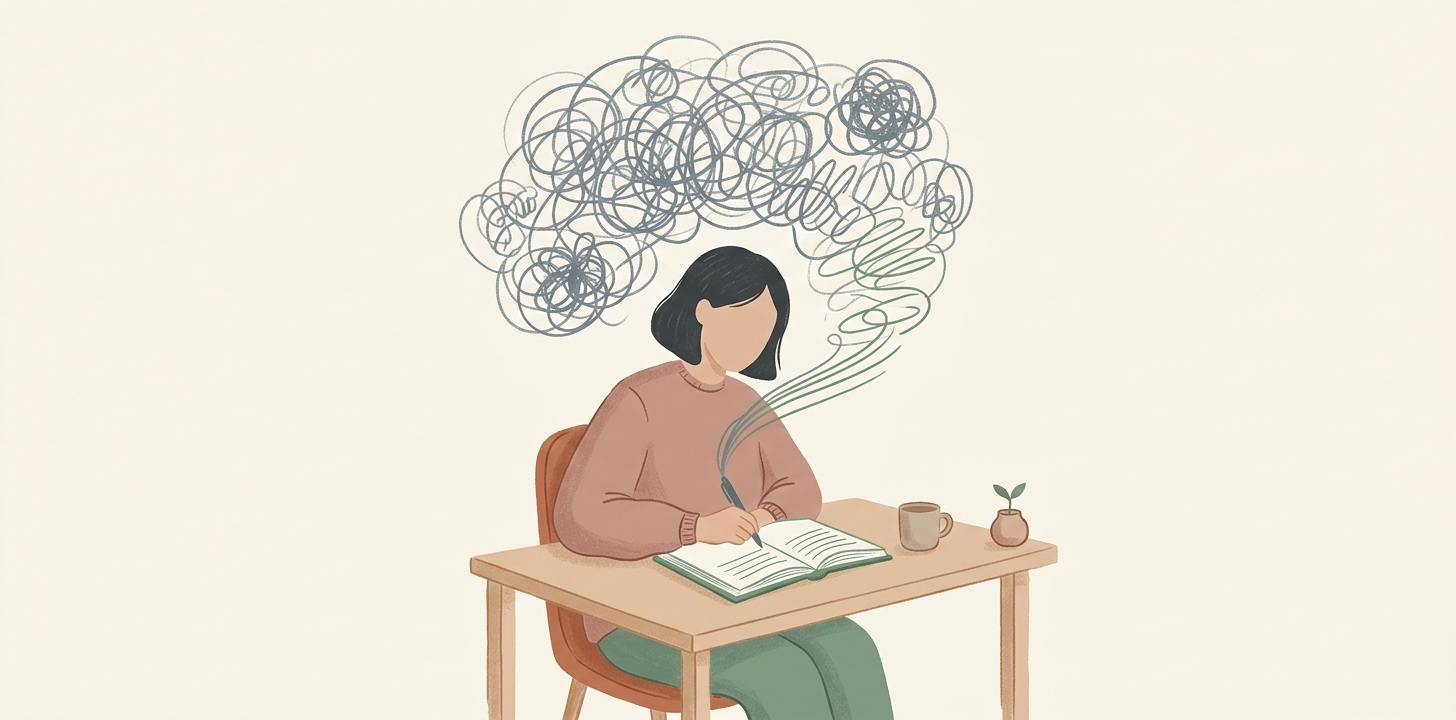
Prompts to help you sit with anxious thoughts and write through them.
→
Uncover your values, dreams, and patterns through thoughtful self-reflection.
→
Evidence-based prompts to build genuine self-confidence from the inside out.
→
Prompts to unblock your creativity and reconnect with your artistic self.
→
Prompts to build genuine self-compassion | beyond affirmations.
→